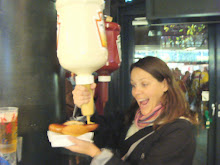
 I couldn't find any Dutch wurst in Amsterdam, so we had to get our fix with a Spanish sausage.
Monday, March 17, 2008
Wurst of the Week - 3/17
I couldn't find any Dutch wurst in Amsterdam, so we had to get our fix with a Spanish sausage.


Sunday, March 16, 2008
Mussels in Brussels

 On Sunday morning we drove to Brussels. Though the city is not as charming as Amsterdam, it has its share of gorgeous squares and charming crooked streets. But, for me the highlight of Brussels was the festival of eating and drinking it offers at every turn. What could be better then a city known for chocolate, waffles, beer, and mussels?
I loved the waffle wagons on the street, ogled over the windows of the chocolate shops, and enjoyed sitting in a pub and having the waiter suggest his favorite beers for a round or two. Dinner here was also a highlight – mussels followed by lobster, clams, and more mussels.
Saturday, March 15, 2008
On the Canals
 Most tourist cities have double-decker tour buses; Amsterdam has canal boats. On Saturday we bought tickets, which were good until noon the next day, and hopped on and hopped off as much as we wanted. Not only did the boats give us a chance to see the city from the water (I particularly loved being able to peek at the other side of the many house boats)) but they served as easy transportation and gave us a place to sit down for a few minutes while still touring the city.
Friday, March 14, 2008
Falling for Amsterdam
 In October I blogged about how much I liked Amsterdam. After visiting with my parents I can truly say that there is way more to this town then coffee shops and the red light district.
We arrived on Friday afternoon and checked into the apartment that I rented – an adorable little Dutch house off a canal just outside the city center. This was a perfect place to call our home base. I really enjoyed being able to come back, sit in the living room and visit rather then heading to a hotel room. José, the owner, has paired the place down to only the bare essentials. There was no clutter to be found, but everything you could want – nice sheets, maps of the city, a coffee pot, and box of cookies – was included.
We visited the Anne Frank house, touring the rooms where the Frank family and four other Jews hid for more then two years; walked through the red-light district (we had to – we were in Amsterdam after all); and then headed to dinner in the Neumarkt district.
Thursday, March 13, 2008
On the Road Again
My parents arrive yesterday. This morning we’re traveling to Amsterdam, then to Brussels. A lot of beer drinking, mussel eating, and chocolate tasting are on the agenda.
My Gemüse Tüte
 This week I purchased my first gemüse tüte, which translates literally to vegetable bag and is German’s answer to a coop. Everything in the bag is organic and they use as much local and seasonal produce as possible.
The bag included lettuce, cabbage, apples, and bok choy, which was the most exciting item to me. Last night I made a Thai coconut curry with turkey that I served with rice and great big helpings of sautéed greens with garlic.
Tuesday, March 11, 2008
Blog and You Shall Receive
 Why is it that when you learn a new word, you hear it everywhere? Or that you discover a new trend, and then you see it everywhere you go? Or you mention something in passing, and then it pops up all over the place?
This phenomena happened to me this week with fava beans. In Monday’s post I mentioned fava beans – also known as broad beans. Then, for the next three days: fava beans, fava beans, everywhere fava beans.
The first couple of time that I saw them I chucked to myself thinking, “I know what a pain in the neck you are to prepare.*” But after seeing them for sale in half a dozen stores I started thinking about how good fava beans are. Fava beans with pasta and Parmesan, sautéed with onions and mushrooms, puréed and smeared on crusty bead – it all sounded so delicious.
I broke down and bought myself one kilo, which is a little over two pounds. That's the maximum amount I have patients to process. What was the deciding factor? Fava beans are one of the first vegetables to appear on the market to announce spring’s impending arrival. I can’t wait to see what comes next?
* An article about fava beans – complete with a brief description of how to prepare them is available on NPR’s Web site.
What I Can’t Say in German
Being able to speak a little German has improved my life here enormously. Simple communications in daily life are no longer a challenge. I am beginning to converse with shopkeepers, can order a meal, and now often understand the announcements on the train.
In my German classes we’ve learned how to politely ask a question. I can say, “may I,” “I’d like,” and “can you please.” What I can’t do is argue. I haven’t learned to say is “no, you’re wrong” or “that’s not correct.”
This is a problem because Germans tend to be very direct people. They don’t beat around the bush, and if something is a problem or difficult they don’t hesitate in telling you.
For example, yesterday I needed to get service done on my car. I was told that the work that I needed couldn’t get done there and was sent home. (This despite the fact that I had an e-mail from the company’s headquarters explaining – in German – the problem.) It took a call to the warranty office, another trip to the dealership, and a call from the warranty office to the dealership to finally convince the “customer service” representative that I was in fact correct. At no time did anyone apologize for the inconvenience.
Monday, March 10, 2008
Mini Pearl
 One of the things that I like the best about my expat life is grocery shopping. Instead of being a rote chore, where I know pretty much exactly what's in each aisle, shopping here is always interesting. I never know what I may find.
This weekend's discovery: fresh pearl onions. When I saw these little treats I was very excited. Every year for Thanksgiving my family eats creamed pearl onions, but we always use frozen onions. I'd never seen them fresh before.
The red flag should have gone up when, on line to check out, the woman in front of me asked what I was going to do with them. She – an authentic German – had never seen them before either.
Saturday night's dinner was to include onion chutney made with the mini pearls. Not two minutes into the project did I realize that the chutney was doomed. These little guys, though adorable, are a pain in the neck to work. Each little onion needed to be peeled individually, a project that made shelling fava beans seem fast and exciting.
For anyone interested in cooking pearl onions, my tip is: Stick with the frozen ones!
Wurst of the Week - 3/10
 The wurst wagon in Bonn's daily market has countless types of headcheese. I love the stripped edges of the meat in the second row. And notice that the one with the egg in the middle.
Saturday, March 8, 2008
Mon Sherry
 I’m obsessed with cooking with Sherry. It started at Thanksgiving when I purchased a bottle to use in the gravy. Since I'm not much of a sherry drinker and the bottle was already opened, I found myself using it to deglaze just about every pot and pan. The Thanksgiving bottle was rapidly replaced. Sherry became staple of my German kitchen
Sherry in mushroom risotto, classic. Sherry in chicken soup, delicious. Sherry in beef stew, perfect.
Around the same time, because winter was upon us, I started making a lot of soups. Each batch of pea soup tasted great, but the color was off. Not green, but a murky brown. I couldn’t figure out why.
Last night, while making potato-leek soup I discovered the problem. After sweating the leeks, as per usual, I deglazed the pot with sherry. Then, when I blended the soup the color was not the creamy white I expected, but nut brown. Like potatoes with gravy.
Then it dawned on me ... gravy ... sherry ... It's the sherry that's mudding the color of my soups.
Friday, March 7, 2008
German Food Receives High Praises
German food gets a bad wrap – there's more to eat here than kraut and wurst. The German people I have met are interested in food and cooking, eating well and healthfully, and support organic and local produce and products. Further diminishing this myth is the current boom in Teutonic cuisine.
Yesterday's New York Times reported that Germany is second only to France in the number of Michelin-starred restaurants, with nine three-star establishments. This fact has infuriated the Italians who only have five. And though I am more of a no-star restaurant diner, I was interested to learn that one Germany's 15 two-star restaurants, Steinheuer Heppingen, is located just outside Bonn.
Thursday, March 6, 2008
Frühstücken
Frühstück is the German noun for breakfast; Frühstücken is the verb. Therefore, in German, you don't say "I had eggs for breakfast." Instead, you say "I breakfast with eggs." (Although, if you were really speaking German you'd say, "I breakfast with liverwurst," but that's another matter all together.)
Lunch (Mittagessen) and dinner (Abendessen) can also be verbs, but they don't seem as strange to me. These words are the time of day (Mittag is mid-day, Abend is evening) plus the verb to eat (essen).
Wednesday, March 5, 2008
What’s So Special About a Brezel?
 Yesterday I realized that I haven’t yet blogged about one of the best German foods I’ve encountered – brezels.
Conceptually they are the same as pretzels available from any NYC street vendor, but German brezels are freshly made and more flavorful. They are available from most bakeries and can often be purchased from small windows that open onto the street.
The Germans like to eat their brezels split in half and buttered, and think it’s strange that Americans eat pretzels with mustard. In addition to the traditional pretzel-shaped brezels most shops also sell a pretzel roll, which can be eaten alone or used for a sandwich.
Subscribe to:
Posts (Atom)


 Posts

